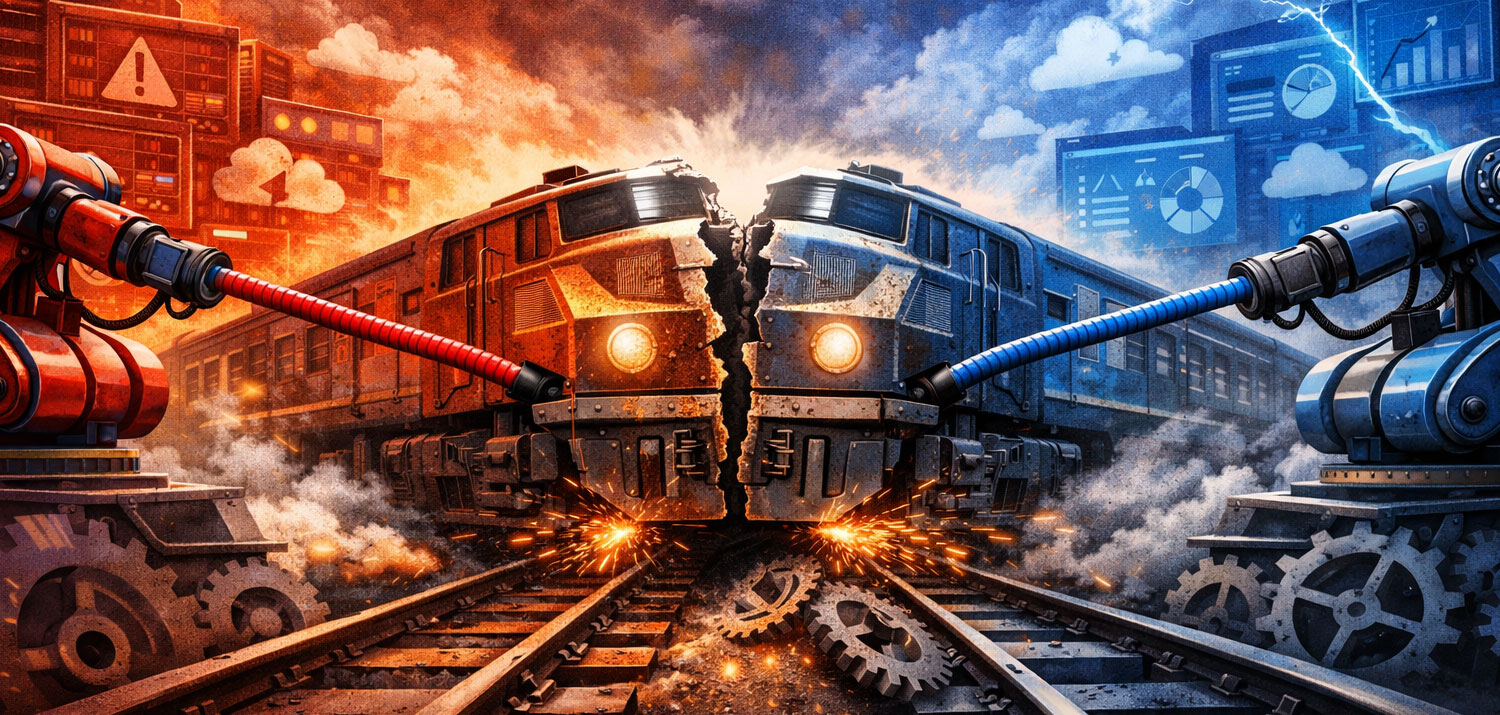
Let’s talk about one of the most common lies we tell ourselves in software:
The platform is slow.
You’ve heard it. You’ve probably said it. You might be saying it right now while staring at a loading spinner and questioning your life choices.
Pages lag. Admins complain. Reports take forever. The frontend feels… heavy. Everything just kind of drags.
And when everything drags, the conclusion feels obvious.
Welp. It’s slow.
So naturally, we reach for the usual bag of tricks:
- upgrade the server
- add caching
- optimize queries
- maybe sprinkle in Redis and whisper a small prayer
And look, sometimes that helps. Sometimes you do actually have a performance problem.
But most of the time? That instinct, the one that screams “speed issue!”, is confidently wrong. You don’t have a slow platform. You have a platform that’s trying to do the software equivalent of walking in six different directions at once.
It’s Not Slow. It’s Fighting You.
And yeah, that sounds dramatic. It’s also accurate. There’s a subtle but important difference between something being slow and something being misaligned.
Slow is clean. Predictable. Almost comforting.
- expensive queries
- underpowered infrastructure
- inefficient code paths
You can profile it. You can measure it. You can fix it and feel like a hero.
Misalignment?
Misalignment is chaos in business casual.
It doesn’t throw errors. It doesn’t show up on a dashboard. It just quietly makes everything harder than it has any right to be.
Misalignment is what happens when:
- your data model doesn’t match your business
- your templates don’t match your data
- your admin UI doesn’t match how people actually work
- your API doesn’t match… anything, really
Everything technically works. Nothing is technically broken. And yet… everything feels like it’s moving through molasses.
That’s not slowness. That’s your platform arguing with itself.
The “This Shouldn’t Be This Hard” Smell
And once you notice it, you can’t unsee it.
If you’ve ever said:
Why is this so hard?
That’s not you being dramatic. That’s your system quietly screaming for help. Misalignment rarely announces itself. It just leaks into everything.
Your data model vs reality
The business thinks in clean, logical concepts.
Your database, meanwhile, is doing interpretive dance.
So now you’ve got:
- fields doing double (or triple) duty
- JSON blobs holding “just this one extra thing” (famous last words)
- naming conventions that made sense three CTOs ago
Every feature becomes a translation layer. And translation is where speed goes to die. Which means the problem didn’t start in your queries.
It started way earlier.
Your templates vs intent
Because once your data is weird, everything downstream inherits the weird.
Frontend wants something simple.
Backend shows up like, “Here’s 14 conditionals and a dream.”
So now your templates are doing gymnastics:
- conditional pyramids
- reshaping data on the fly
- duct-taping output into something usable
And somewhere along the way, that file becomes sacred. Not because it’s good. Because nobody wants to touch it and find out what breaks.
Your admin UI vs actual workflows
And of course, it’s not just a developer problem. Your users get to enjoy this too.
Users shouldn’t need a training manual to do basic tasks.
And yet here we are:
- six clicks for a two-step process
- fields nobody understands but everyone’s afraid to delete
- “Just follow this doc” like it’s a rite of passage
If your UI requires onboarding, a walkthrough, and emotional support…
It’s not a UI. It’s an escape room.
Your API vs reality
By now, the pattern should feel… uncomfortably familiar. The API exists. On paper.
But using it feels like:
- guessing what shape you’ll get back
- over-fetching everything “just in case”
- under-fetching and making five follow-up calls
- reshaping the response like you’re kneading dough
So devs either wrap it, rewrite it, or quietly pretend it doesn’t exist. All strong signals that things are going great.
So You Start Fixing “Performance”
And this is where smart teams accidentally make things worse. Because the system feels slow, you do the logical thing:
you optimize.
- add caching layers
- tune queries
- upgrade infrastructure
- introduce queues, workers, background jobs
And none of that is wrong. It's just solving the symptom. Because if the real issue is misalignment, you’re basically putting a turbocharger on a car with crooked wheels
Sure, it goes faster.
Also still terrifying to drive.
Why Misalignment Feels Like Slowness
So why does this trap catch so many teams?
Because misalignment doesn’t stay in one place. It spreads. It compounds. It taxes everything.
- Data layer: awkward structures → inefficient queries
- Application layer: extra transformations → more processing
- Frontend: constant reshaping -> heavier rendering
- Humans: confusion -> hesitation -> mistakes -> Slack threads
And let’s be honest: humans are the slowest part of any system. If your users are pausing, second-guessing, or working around the system…
That feels like slowness.
Even if your servers are absolutely crushing it.
What Alignment Actually Looks Like
So what does “fixed” actually look like? Spoiler: it’s not flashy. It’s boring. Predictable. Almost suspiciously smooth.
- your data matches real-world concepts
- your templates don’t require a survival guide
- your admin UI feels obvious (wild, I know)
- your API responses make sense the first time
- new features don’t start with “okay but how do we hack this in”
You stop fighting the system.
Which is when something weird happens; it gets faster… without you trying to make it faster.
Because alignment removes resistance. And resistance is what was slowing you down the whole time.
Quick Gut Check
Still not convinced? Totally fair.
Let’s make it weird.
- Do you have multiple ways to do the same thing?
- Are there parts of the system people actively avoid?
- Does every feature require “just one exception”?
- Does your documentation read like a legal disclaimer?
- Do your developers sigh before opening certain files?
If you’re nodding along…
Congratulations.
It’s not a performance problem.
It’s a “what even is this system anymore” problem.
Fixing It (Without Burning It All Down)
Here’s the part everyone braces for, “Nooooo don’t say rewrite!”
Relax. You don’t always need to nuke it from orbit. But you do need to change how you look at it.
Stop asking:
Where is it slow?
Start asking:
Where are things out of sync?
Because that’s where the real leverage is. Look for the seams:
- where data doesn’t match usage
- where workflows don’t match UI
- where APIs don’t match consumers
And fix those.
Not all at once. Not in some grand, career-defining rewrite. Just small, intentional realignments:
- reshape a model
- simplify a response
- remove a weird abstraction
- make the system agree with itself again
You’d be shocked how much faster things feel when everything stops arguing.
The Real Problem
At this point, you already know; your platform isn’t dragging. It’s resisting. And no amount of caching, scaling, or clever engineering fixes a system that fundamentally disagrees with itself.
So the next time someone says:
The platform is slow
Give it a second. Because speed might not be the problem. Alignment might be.
Speed isn’t something you bolt on later. It’s what happens when everything lines up. When your data, your code, your UI, and your workflows all stop arguing things move.
Naturally.