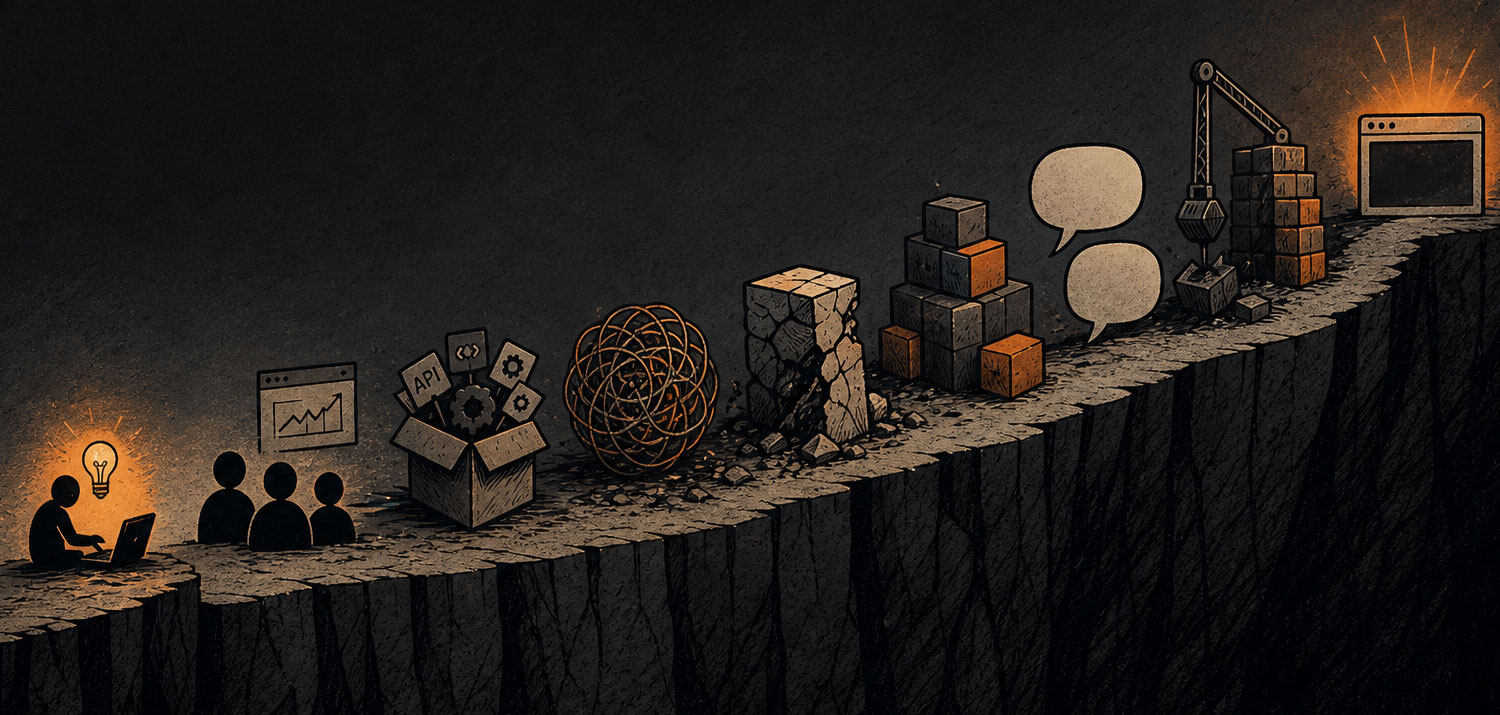
After a couple decades of this hilarity, I've noticed a legit and real pattern when it comes to software development and release cycles. And, it is a cycle. Step 1, Step 2, Step 3, and on and on. Most software platforms begin life the same way. A small team. A clear idea. A framework or stack everybody is excited about. A sprint board still containing words like “MVP” and “lean”. And there's always some asshole confidently saying (me: I'm always the asshole saying dumb shit like this):
“We’ll keep this one clean. This one'll be different”
Suckers. Adorable suckers, but suckers nonetheless.
In the beginning of the process, software feels simple because it is simple. The entire platform can fit inside a few developers’ heads at once. Decisions happen quickly. Features ship fast. There’s very little process because there doesn’t need to be. Early on, this is exactly how it should work.
Nobody needs twelve abstraction layers and an event-driven hexagonal CQRS blockchain-enabled refrigerator architecture to validate whether users even want the product. You just need momentum. You need feedback. You need something that exists.
So developers make practical decisions:
- hardcoded assumptions and designs
- the tiniest of controllers and fattest of models
- direct database access
- duplicated logic (that they'll totally get to later)
- “temporary” shortcuts
- helper functions that slowly become an undocumented internal framework
And it works. As it's supposed to tat this stage.
Until it works too well.
That’s usually where the trouble starts. Because, success... well success changes software.
- Features accumulate.
- Integrations appear.
- Data grows.
- Teams expand.
- Roadmaps become more aggressive.
- Sales starts promising things during calls without asking engineering first. An ancient and sacred business tradition.
The platform slowly transforms from:
“an MVP”
into:
“a product.”
and into:
"a system"
And systems behave differently.
Every new feature starts interacting with old decisions. Every shortcut begins collecting interest. Every workaround becomes part of the architecture whether anyone intended it or not.
At first, nobody notices. Then one day:
- deployments become stressful
- regressions appear out of nowhere
- onboarding new developers takes months
- performance problems become mysterious
- everyone becomes afraid to touch certain parts of the codebase
Eventually somebody says:
“Honestly, we should probably rebuild this.”
And now we’ve entered one of software engineering’s oldest recurring cycles.
Because almost every successful platform follows roughly the same evolutionary path.
- The technologies change.
- The buzzwords change.
- The conference talks definitely change.
But the underlying pattern remains surprisingly consistent.
Over time, platforms tend to move through a predictable series of phases. Not because developers are incompetent. Not because frameworks fail. Not because one person made a catastrophic decision in 2017 involving Redis and unchecked optimism.
Mostly because software evolves under pressure. And pressure changes architecture whether you plan for it or not.
This series explores those phases.
Not academically. Not from the perspective of pristine greenfield architecture diagrams nobody has ever actually deployed.
But from the perspective of real systems. Real teams. Real constraints. Real production environments held together by caffeine, deadlines, and increasingly concerning Slack messages.
So let’s walk through the lifecycle. Because if you’ve worked on long-running software platforms long enough, you’ve probably lived through most of these already. Possibly all at the same company. Possibly all in the same quarter.
Phase 1: The Prototype
This is the honeymoon phase.
Speed matters more than architecture. Iteration matters more than elegance. The goal is simple:
Make the thing real.
And honestly, this phase fucking rules.
The team is small. The scope is manageable. Complexity is low. Nobody has created a reporting subsystem capable of generating 14,000-line SQL queries yet.
The prototype succeeds because it can move quickly without much organizational drag.
The danger is that successful shortcuts rarely stay temporary.
You can read the full essay now.
Phase 2: The Early Product
Reality enters the chat.
Now there are:
- real users
- real production traffic
- real edge cases
- real business expectations
This is where the architecture begins hardening, often accidentally.
Patterns become conventions. Conventions become dependencies. Dependencies become “how the platform works.”
The system still feels manageable at this point, but complexity has started compounding beneath the surface.
Quietly. Patiently. Like mold behind drywall.
You can read the full essay now.
Phase 3: Feature Expansion
This is where businesses get ambitious.
New integrations. New APIs. Admin tooling. Automation. Reporting. Permissions. Billing. Search. Analytics. Dashboards explaining why the dashboards are slow.
Every addition seems reasonable in isolation.
That’s what makes this phase dangerous.
Complexity rarely arrives all at once. It arrives disguised as:
“We just need one more feature.”
Repeated several hundred times over multiple fiscal quarters.
You can read the full essay now.
Phase 4: Complexity
Eventually the platform changes shape.
Boundaries become blurry. Logic gets duplicated. Data flows stop making sense. Developers become archaeologists.
Nobody fully understands the entire system anymore.
Which means every deployment starts carrying a tiny bit of emotional risk.
You know. For fun.
You can read the full essay now.
Phase 5: Architecture Strain
This is where platforms begin fighting the team maintaining them.
Deployments become fragile. Performance becomes unpredictable. Regression bugs appear in completely unrelated systems. Onboarding new developers starts taking forever because explaining the architecture now requires diagrams, mythology, and emotional preparation.
Decisions made years earlier suddenly matter a lot.
Unfortunately, many of the people who made those decisions are now gone.
Probably happier.
You can read the full essay now.
Phase 6: Stabilization Attempts
This phase is fascinating because it’s where organizations start trying to “solve” accumulated complexity.
This usually involves:
- refactors
- infrastructure changes
- aggressive caching
- queue systems
- service extraction
- observability tooling
- microservices appearing like raccoons near unsecured garbage
Sometimes these efforts help.
Sometimes they create entirely new categories of problems.
A shocking amount of modern infrastructure is essentially:
“We added more systems to compensate for the original systems.”
Which, to be fair, is also how most cities operate.
You can read the full essay now.
Phase 7: The Rebuild Conversation
Eventually every engineering organization reaches this moment.
Someone asks:
“Should we rewrite it?”
This conversation is rarely technical.
It’s emotional. Political. Financial. Existential.
Some people see a rewrite as salvation. Others see it as organizational suicide.
Both sides usually have valid points.
This is also the phase where decades of software engineering trauma suddenly become very loud online.
You can read the full essay now.
Phase 8: The Rewrite
Sometimes the rebuild actually happens.
Ideally the new system includes:
- clearer boundaries
- stronger domain modeling
- better architectural discipline
- lessons learned from the original platform
Ideally.
What often actually happens is:
“We recreated the same problems with newer tooling and significantly more Kubernetes.”
Still, successful rewrites can happen. But only when organizations understand the real problems they’re trying to solve.
Which is harder than most teams expect.
You can read the full essay now.
Phase 9: The New Platform
Eventually the rebuilt system stabilizes.
Things improve. Velocity returns. Developers feel optimistic again. Conference talks get written. LinkedIn posts become unbearable.
And slowly, over time, the cycle begins again.
Because every successful platform eventually becomes legacy software.
That’s normal.
The goal isn’t to avoid evolution forever. That’s impossible.
The goal is to build systems that can evolve gracefully without destroying the teams responsible for maintaining them.
Which turns out to be much harder than installing whatever JavaScript framework everybody is emotionally attached to this week.
You can read the full essay now.
Over the next several articles, we’re going to dig into each phase individually:
- why it happens
- what teams usually get wrong
- which tradeoffs are actually rational
- how complexity compounds
- and why so many platforms eventually end up fighting the very people trying to maintain them
Because once you recognize the pattern, you start seeing it everywhere. Including your own platform.
Especially your own platform.