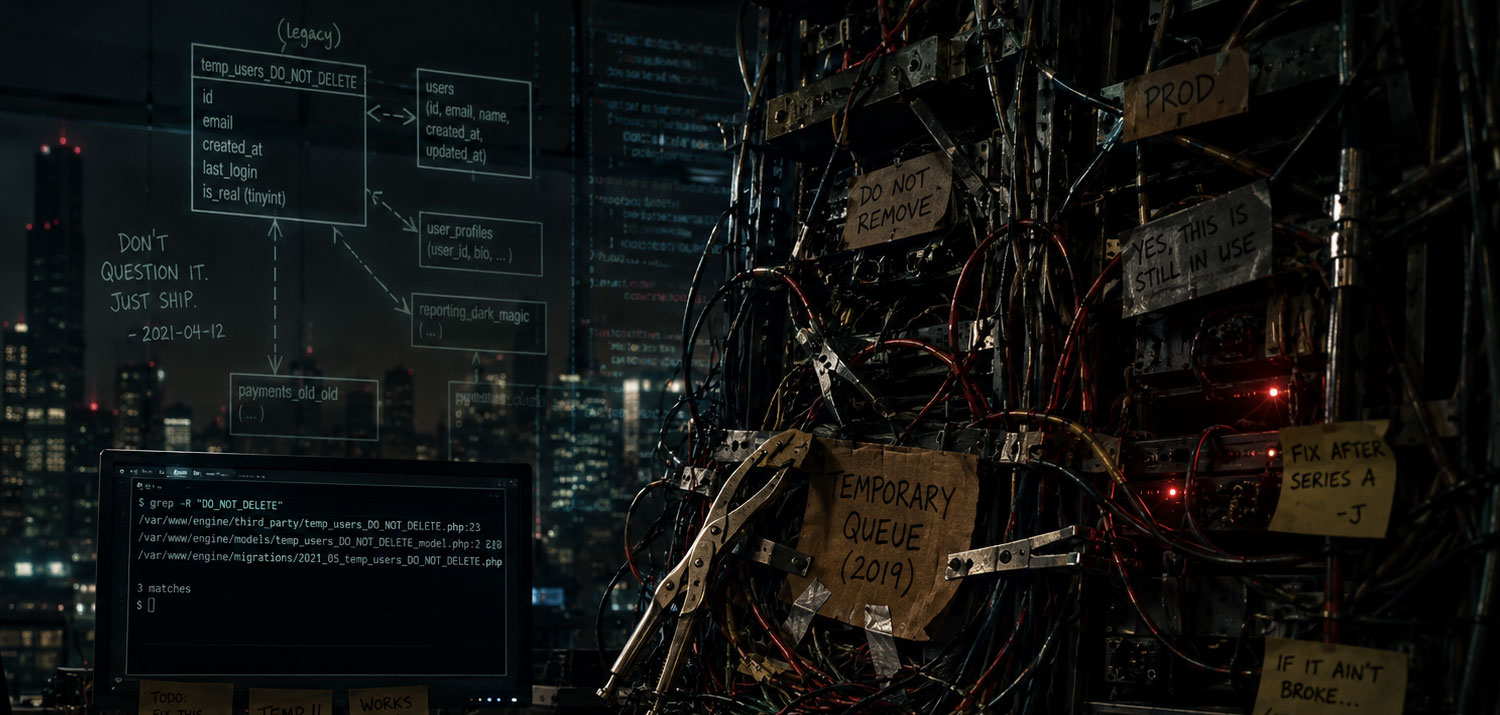
Every experienced developer eventually inherits a system that feels less like software and more like a crime scene with uptime requirements. A codebase like that feels more like an archaeological dig, layer after layer of decisions that made perfect sense at the time, fossilized into production. Nothing is more permanent than a temporary table.
You find a database table called temp_users_DO_NOT_DELETE that's been there for four years. You find a helper class with 3,000 lines of methods that do things no one can quite explain anymore. You find comments like // TODO: fix this properly timestamped from a year before the company raised its Series A.
For example, my last venture, VITY that crashed and burned, was built fast, really fast, on ExpressionEngine 2.0, back when the idea was just an experiment worth proving out. The deal was simple: find out if the thing works, and if it does, rebuild it properly. It's a deal developers make all the time, usually in good faith, often over coffee, almost never in writing.
The punchline, if you haven't guessed it: we did not rebuild. I got to live with my decisions and shortcuts for 6 looooooong years. But. It. Fucking worked.
The Goal Isn't Good Software
Here's something that gets lost in the mythology of craftsmanship: in the early days of a startup, bad architecture is often the economically rational choice. For me, with VITY, I just had to prove people gave a shit. "Will people use our tool?", was the only end goal. I HAD to get a system working and functional which showcased a specific though pretty complicated flow (basically, a dating site for social influencers and advertisers to Tinder up but with escrow).
The rationale at the time was we'd be legit FOOLS to start from scratch at this phase. At the time, it was a nugget of an idea, discussed over drinks hearing about a friend's woes. We knew it'd help her, but how big a market was there to be had on this idea? Could we even fund it long term? It was determined we could self fund this for 3 months but no more. Budgets and times, man, budgets and time...
All that to say, our job wasn't to write elegant code. Our job was to find out if anyone wanted what we were building before we ran out of money. Speed isn't a compromise; it's the strategy. Every hour spent debating abstraction layers is an hour not spent learning whether users will actually pay for the damn thing.
This is why experienced developers knowingly cut corners in prototype phase. They're not being lazy. They're making a bet: if this works, we'll have the resources to fix it; if it doesn't work, none of this will matter anyway. It's a reasonable bet. It just has a catch.
Architecture gets intentionally sacrificed on the altar of velocity, and that's fine, right up until it isn't.
Premature Architecture Is Its Own Disaster
To be clear about what we're not arguing here: the opposite of a messy prototype is not a clean one. The opposite of a messy prototype, attempted too early, is a beautiful system that solves a problem nobody has confirmed exists yet.
Some developers will build a distributed event bus before confirming users can successfully log in.
The architecture astronauts, the ones who can't write a simple CRUD endpoint without first designing a hexagonal abstraction layer for it, cause their own category of damage. They optimize for a scale that never comes, build for requirements that shift, and delay the one thing that actually matters in the early phase: learning. Nobody has ever achieved product-market fit because their domain layer was beautifully abstracted.
The word "MVP" has probably justified more crimes against software architecture than it has prevented. But the sin cuts both ways. Overengineering a product nobody's validated yet is just a more dignified form of the same mistake.
The Shortcut Economy
In a working prototype, you'll find a predictable set of decisions: giant controllers that do too much, helper classes that became junk drawers, hardcoded assumptions about data that turned out not to hold, direct database access from places it has no business being, duplicated business logic spread across three files, "temporary" queues that are now load-bearing, config values baked into the code like fossils in amber.
The remarkable thing is that these decisions often work beautifully early on. A monolithic controller is easy to reason about when there's one developer and one use case. Hardcoded values are fine when you haven't hit an edge case yet. Direct DB access is fast to write and fast to execute when your dataset is small.
The shortcuts don't become problems immediately. They become problems gradually, then all at once.
Why Prototypes Feel So Good
There's an emotional dimension to this that people don't talk about enough.
Working in a prototype codebase, a real one, early-stage, small team, is genuinely one of the best feelings in software development. The whole system fits in your head. Feedback is immediate. There's no process overhead, no architectural review board, no ticket system. You have an idea at 10am and it's in production by lunch. You understand every line of every file. Complexity is low. Morale is high.
Velocity becomes addictive in exactly the way that word implies. You start to associate moving fast with doing things right, because for a while, in that context, they're the same thing.
The contrast with later phases, more developers, more complexity, more process, more drag, can feel like a betrayal. It isn't. It's just growth. But the emotional memory of how easy it used to be creates a powerful resistance to the structural changes that growth requires.
The Moment the Prototype Becomes a Product
There is a specific, identifiable moment when a prototype stops being a prototype. It usually isn't announced. Nobody schedules a meeting to declare that the experimental phase is over.
Instead: the first real customer signs up. Production data accumulates. Onboarding becomes a thing. Someone asks about billing. The support queue appears from nowhere. Edge cases multiply. Expectations solidify.
These aren't software events. They're business events. And they happen on a timeline that has no relationship to the state of the code. The prototype doesn't wait for a refactor before acquiring customers. Reality ships on its own schedule.
The dangerous thing about successful prototypes is that they succeed.
And success, in the early stage, looks like the same codebase doing more than it was ever designed to do, stretched, patched, bent into shapes it wasn't meant to hold, until the temporary decisions and the permanent infrastructure become indistinguishable from each other.
Most platforms don't collapse because the prototype was messy. They collapse because nobody realized the prototype phase had ended.
The code that was supposed to be replaced becomes the code that everything else depends on. The shortcuts become load-bearing. The temporary architecture becomes the foundation. And somewhere along the way, the plan to rebuild quietly stops being a plan and becomes a memory.
One day, a new developer joins the company and assumes the prototype was intentional.
And now it is.