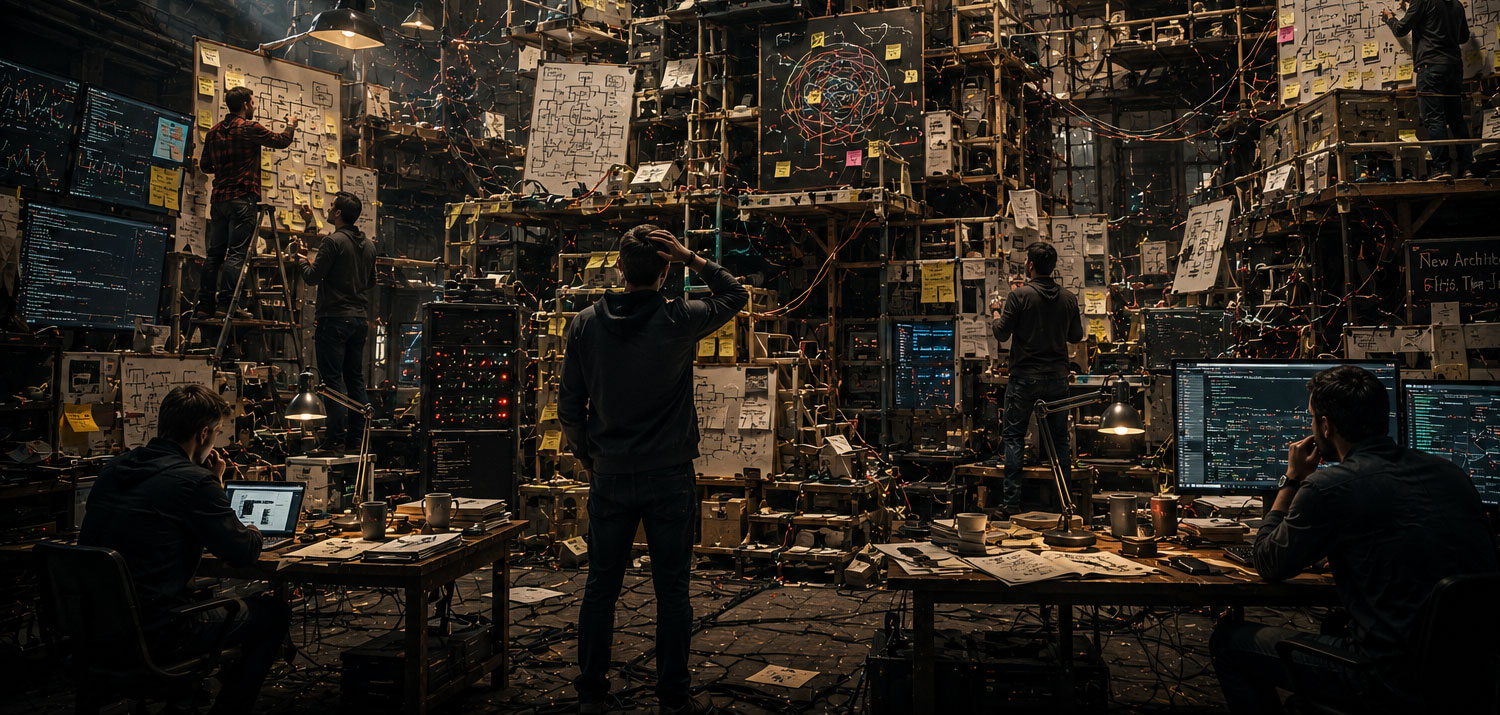
At some point every struggling platform enters what can only be described as Framework Season.
You will know Framework Season has arrived because suddenly everyone is talking about migrating to Laravel. Not because the current framework is wrong, exactly, but because Laravel has nicer syntax and a better ORM and someone just watched a Laracasts video and now they have feelings.
Then someone else says actually we should look at Symfony, because Laravel is fine for small apps but we're an enterprise now, and the word "enterprise" does the thing it always does in engineering discussions, which is end them.
A service container gets introduced.
Then Doctrine, because Eloquent is apparently an antipattern if you squint at it long enough.
Then the repository pattern, which someone read about in a Martin Fowler book they bought three years ago and have been waiting for the right moment to deploy.
Then a service layer on top of the repositories.
Then value objects.
Then a domain events system, hand rolled, because the built-in event system "doesn't fit the architecture."
Then the architecture diagram, which had previously been a diagram, now resembles a conspiracy board in a thriller where the detective has been awake for seventy-two hours and is starting to question his life choices.
Nothing says "we understand the problem" quite like introducing seventeen new moving parts.
The instinct is understandable. The execution, as we will discuss, is variable.
The Search for Stability
Before the humor, the pain, because the pain is real and it deserves to be acknowledged directly.
By this phase, the engineering team is exhausted in a specific, grinding way that is different from ordinary tiredness. They have spent months, possibly years, working in a system that has learned to surprise them. And not pleasantly. Every deployment is a small act of courage followed by twenty minutes of staring at logs. Every release cycle surfaces regressions in code that nobody touched, in features that were working just fine last week, for reasons that take two days to trace to a Composer dependency that updated silently and changed the behavior of a method that four unrelated parts of the application were relying on in subtly different ways.
Support tickets arrive faster than they can be closed. The error logs have become background noise. The team has developed an informal classification system for which exceptions are worth investigating versus which ones have been there since 2019 and are somehow load-bearing (I lived this one BTW). This is a sane adaptation to an insane situation. It is not how error logs are supposed to work.
Executives are watching the velocity numbers and asking questions that are hard to answer honestly. Engineering leadership is getting pressure from both directions: from above, where expectations are about features and timelines, and from below, where engineers are quietly telling anyone who will listen that the codebase is not okay and hasn't been for a while. The search for stability comes from a real place. The question is not whether to act; it is whether the action will address the actual problem or create new ones alongside the old ones.
Refactoring Begins
The first response, and usually the most sensible one, is to try to clean up what exists rather than replace it. Remove the duplication. Untangle the coupling. Extract the business logic that somehow ended up in the controller and put it somewhere that makes sense. Pay down some of the debt.
Refactoring is chronically underfunded, for a reason that is almost entirely structural. Its benefits are preventative, which means they are invisible. A successful refactor produces a codebase that is easier to work in, with fewer surprising failures, faster development cycles, and a lower onboarding burden for new engineers. None of those benefits appear on a roadmap. None of them ship as features. The product of a successful refactor is the absence of a problem that has not happened yet, which turns out to be a very difficult thing to put in a quarterly plan or spreadsheet. Refactoring competes directly with visible work, which is an unfair fight.
So refactoring gets the time left over after features ship, which is never enough time, which means it never quite finishes. The duplication is reduced but not eliminated. The coupling is loosened but not resolved. The branch that was supposed to clean up the service layer sits open for two months, gets merged in a state that is better than it was and worse than it should be, and everyone agrees to pick it up next sprint. The sprint after that is when the big customer deadline is though, so...
The Stack Starts Multiplying
And then, Framework Season.
The reasoning, at each step, is entirely coherent. The application is hitting memory limits; a job queue will move the heavy processing out of the request cycle, and Beanstalkd is fine, or maybe Horizon, or maybe SQS because the infrastructure team has opinions. The codebase has no consistent pattern for data access; the repository pattern will fix that, and we should probably introduce an interface for each repository so we can swap implementations later. We will never actually do that. But the option is nice to have. The models are doing too much; observers will handle the side effects, except now the side effects are invisible and fire in an order that depends on how the observers were registered, which depends on which service provider loaded first, which is a thing you now have to know.
The ORM starts getting blamed for the performance problems. Someone benchmarks raw PDO queries and shares the results in Slack with an alarming number of exclamation points. A hybrid approach gets introduced: the ORM for convenience, raw queries for "critical paths," and a growing body of institutional knowledge about which is which. A caching layer appears because the queries are slow. Memcached is already running from a previous initiative, but Redis is better for certain use cases, so now both are running, different parts of the application use different ones, and there is no document explaining which does what.
Half the industry now consists of tools designed to help companies survive the complexity introduced by other tools. The PHP ecosystem, to its credit, has been doing this longer than most.
Complexity Shifts Instead of Disappearing
Here is the thing nobody says loudly enough at the beginning of Framework Season: you can move complexity. You rarely eliminate it. And if you are not careful about where you move it, you can make it significantly harder to find.
The old PHP 4-era spaghetti codebase, the one everyone is embarrassed about, had a certain horrible legibility to it. You could read it top to bottom. The database query was right there in the template file, which was wrong in every way a thing can be architecturally wrong, but when something broke you could find it. You opened the file. You read the file. You found the problem. It was terrible and it worked.
The new application, the clean one, is a cathedral of abstraction. It has service providers, facades, contracts, repositories, a domain event system, a middleware pipeline, a job queue, observers firing on model save, policies governing authorization, and a notification class handling the email that follows. Every layer is individually correct. The seams between them are where the production bugs live. Tracing a bug through six layers of indirection in a framework that does significant amounts of magic through static proxies is an experience that will cause you to reconsider your career choices at around hour four.
Doctrine is a particularly instructive example. The theory is right: the repository pattern separates persistence from domain logic, the unit of work pattern batches database operations intelligently, entities can be tested without touching the database. The practice, at scale, means every developer needs to understand entity lifecycle management, identity maps, proxy objects, and the precise conditions under which flushing the entity manager will or will not cascade to related objects. That turns out to be one of those things that is simple in the documentation and subtle in production. Trading one kind of complexity for another is sometimes the right move. It should go in with open eyes.
Stabilization Theater
Not all stabilization efforts are genuine. Some of them are.
Stabilization theater is what happens when an organization adopts the aesthetic of solving the problem without addressing the substance of it. A new set of coding standards gets introduced, enforced by PHP_CodeSniffer in the CI pipeline. It catches formatting violations with great efficiency while the actual architectural problems continue accumulating untouched. A dependency injection container gets wired up because someone read that DI containers are best practice, and they are, except that the application now has a container managing some of its dependencies and global state managing the rest. The container configuration is the most complex file in the codebase, with sixty-three service bindings, fourteen of which are commented out with no explanation.
Many teams adopt design patterns the same way medieval doctors used leeches: with complete confidence in the mechanism, a framework that sounds authoritative, and outcomes that depend heavily on context they did not account for.
Cargo cult engineering is copying the solutions of successful teams without experiencing the problems those solutions were designed to solve. The Symfony best practices documentation was written for a certain class of application, maintained by a certain size team, with a certain kind of organizational structure. Applying it to a five-person team maintaining a ten-year-old CodeIgniter application is a category error. It will produce a codebase that is following all the rules and not actually easier to work in, because the rules were written for different constraints.
Someone will propose a full migration from the existing framework to Laravel, or from Laravel to Symfony, or from Symfony to something more "lightweight." The proposal will be entirely sincere, mostly correct about the problems with the current system, and completely optimistic about the cost of the migration. The organization will either attempt it and discover those costs directly, or defer it and continue accumulating the technical pressure that made the proposal feel necessary. There is a third option: do a partial migration and run two frameworks simultaneously for four years. That option is always available and never as temporary as it sounds at the time.
Eventually every organization reaches the same uncomfortable realization: the platform is not merely difficult to maintain. It may fundamentally need to change.
Not the framework. Not the ORM. Not the job queue or the caching layer or the number of service providers registered at boot. The platform itself, the accumulated decisions of however many years, the fossilized assumptions, the temporary architecture that became permanent.
This is where the rebuild conversation begins. Which is, almost without exception, the most dangerous conversation a software company can have.