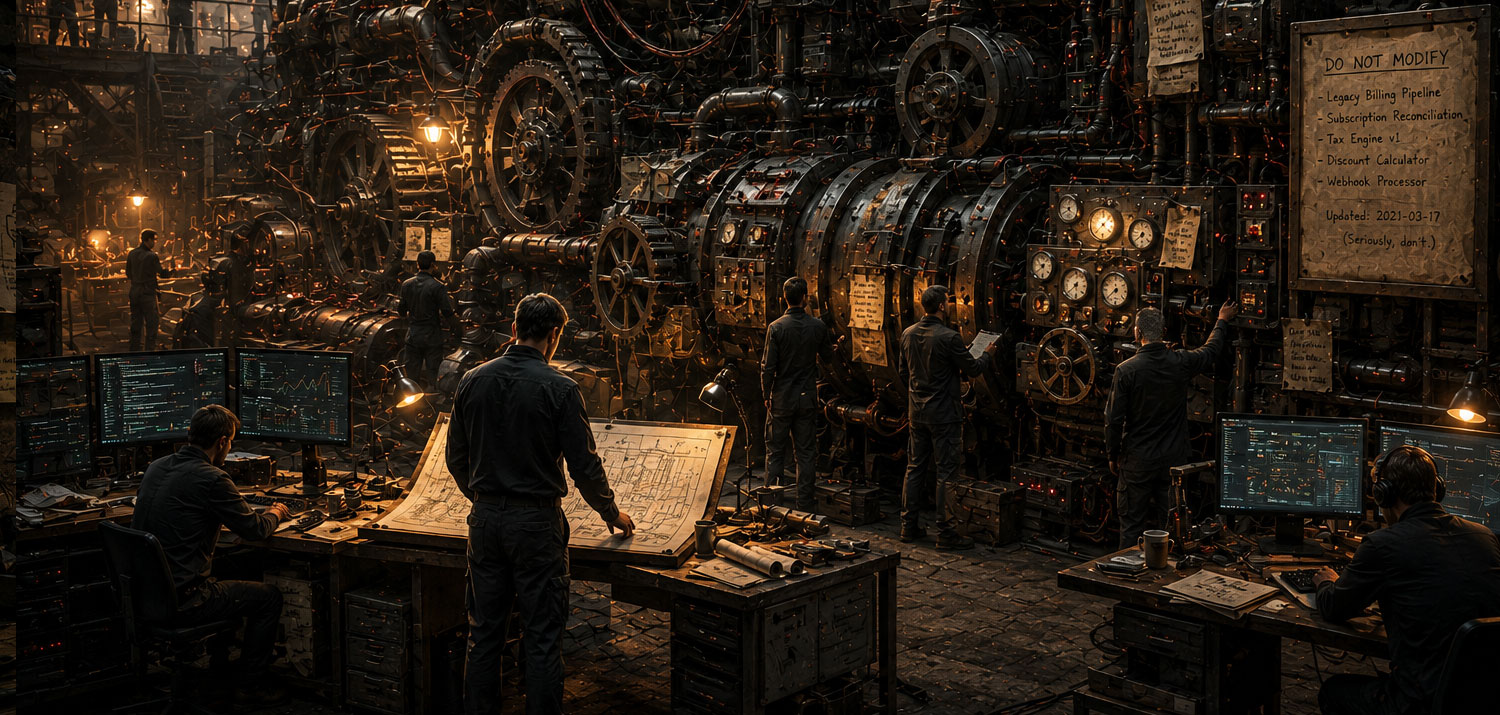
This is usually the phase where deployments start feeling like hostage negotiations.
Releases that used to be a Deployer script and a queue worker restart now require a cast of participants, a pre-flight checklist, and a group chat that stays open for the next two hours in case something goes sideways. Regressions are no longer surprising; they are expected, factored into the schedule, treated as the cost of doing business rather than evidence of a problem worth solving. Scaling issues surface in production rather than in planning because nobody fully understood the load patterns when the architecture was designed, and the architecture has never been in a position to be revisited.
There is always one subsystem nobody is emotionally prepared to touch. Everyone on the team knows which one it is. The conversation goes the same way every time: we should really deal with that at some point, followed by a silence that means not this sprint, not this quarter, maybe not ever.
Somewhere in the company there is a Confluence page titled DO NOT MODIFY. It has not been updated since 2021. It is the most carefully read document in the entire organization.
The Cost of Earlier Decisions Arrives
In Phase 1, certain assumptions got baked in. The data model assumed a single-tenant structure because there was only one customer, so user_id went on every table and the concept of a tenant_id never came up. The authentication system was hand-rolled because the framework's built-in auth "didn't quite fit," which made sense at the time and has made every SSO conversation harder ever since. The job queue was sized for a workload that was, at the time, hypothetical. These were not bad decisions; they were rational decisions made with the information available, under constraints that made anything more ambitious unrealistic.
Phase 5 is when the invoice arrives.
The single-tenant assumption is now the reason a multi-tenant enterprise deal is an eight-month engineering project rather than a configuration option. Every query, every scope, every cached result assumes one account context. Retrofitting tenant isolation into a schema that was never designed for it is not a refactor; it is a migration across the entire surface area of the application, running live, with production data, on a system that cannot be taken offline. The hand-rolled auth is the reason SSO integration requires two weeks of investigation before anyone can write a line of code. The job queue is the reason the system falls behind under load in ways that are difficult to diagnose, because the queue was designed for tens of jobs per minute and is now processing thousands.
The original decisions were sensible. The problem is that sensible decisions made for one context do not automatically update themselves when the context changes. Architecture optimized for the reality of Phase 1 is now running in the reality of Phase 5, and the gap between those two realities is the source of most of the friction the team lives with every day.
Historical baggage is just yesterday's pragmatism, compounded.
The Platform Stops Being Understandable
There is a threshold beyond which a system's complexity exceeds human reasoning capacity. Platforms in Phase 5 have crossed it.
The coupling is no longer visible in the code. It operates at runtime, through behaviors that surface only under specific conditions, in specific sequences, with specific data. A change to how a queued job processes records turns out to affect a shared cache key, which turns out to affect a dashboard calculation that a customer notices is wrong three days later. The chain of causation is real. Tracing it after the fact is an archaeological project, involving git bisect, log correlation across multiple channels, and at least one conversation that starts with "I think I remember why that works that way."
Debugging in this environment is not a process of reading code and reasoning about it. It is a process of forming hypotheses and running experiments, often in production, because no staging environment accurately replicates the data volume, the cache state, the queue backlog, or the specific combination of conditions required to reproduce the issue. Senior engineers can do this. It is slow, expensive, and not a skill you can train into someone in their first three months.
Dependency chains have grown long enough that understanding a single component requires understanding its context, which requires understanding the components that shape that context. The platform has outgrown the team's ability to hold it in mind, and that gap widens every time a new layer gets added without a corresponding investment in documentation that anyone will actually read.
Organizational Friction Explodes
When trust in a system degrades, process grows to compensate. This is not a failure of leadership; it is a rational organizational response to genuine instability. The release checklist exists because a deploy without one caused an incident. The cross-team coordination meeting exists because a schema change in one service broke an assumption in another and nobody found out until a customer reported it. The two-week QA cycle exists because shorter cycles have missed things, repeatedly, in ways that were expensive to fix.
Process often grows where trust in the system disappears.
The result is a set of structures that are individually defensible and collectively exhausting. Deploying a change now involves scheduling, coordination, review cycles, approval gates, a migration dry-run in staging, an OPcache flush sequence, a queue worker drain, and a post-deploy monitoring window. The overhead is not bureaucratic malice; it is scar tissue from previous incidents, institutional memory expressed as procedure.
The people caught in this system know exactly how slow it feels. They also know, usually, why each step exists. The frustration comes from knowing that the process is simultaneously too slow and the only thing standing between a routine Tuesday deploy and a two-hour outage. Both things are true. That is Phase 5.
The Rise of Fear-Based Engineering
The most stable systems are often the ones nobody dares modify anymore.
Stability, in this context, is not a property of the system; it is a property of how people interact with it. The code that has not changed in three years has not changed because it works well and is well understood. It has not changed because everyone who has worked near it learned, through experience, that changing it produces unpredictable results. The collective decision, never formally made, is to leave it alone. It might be a PHP 5-era class using globals and static state throughout that somehow still runs. It might be the billing module nobody has fully understood since the developer who wrote it moved on. It does not matter what it is. Everyone knows where it is, and everyone steers around it.
This is fear-based engineering, and it is a rational adaptation to an irrational environment. Tiny PRs that change as little as possible. Rollback plans drafted before any change of consequence. Requests for extensive review on changes that would have been a single approval two phases ago. A quiet organizational preference for stagnation over risk, because the risk has proven itself real enough times to be taken seriously.
The problem with fear-based engineering is not that it is irrational; it is that it makes progress impossible. A platform that cannot be safely modified cannot be improved. Features the business needs cannot be built. Technical problems cannot be addressed. The organization stalls, not from lack of will or skill, but because the system has made change too costly to pursue.
Hiring Stops Solving the Problem
The instinct, when a team is slow, is to make the team larger. It is a reasonable instinct. It is also largely wrong at this phase.
The problem is not capacity; it is comprehensibility, and comprehensibility does not scale with headcount. Every new developer who joins is another person who needs to understand the billing system: why the webhook handler has that retry condition, why subscription creation goes through a different code path than renewal, which Artisan commands are safe to run in production and which ones have footnotes. Understanding the billing system takes months. During those months, the new developer is a net drain on the existing team's time.
At a certain point, every new developer is just another person you must explain the billing system to.
Beyond onboarding, adding engineers to a complex system increases the coordination overhead required to keep everyone aligned. More developers means more potential for conflicting assumptions, more surface area for misunderstandings to propagate, more pull requests touching the same fragile parts of the codebase in the same week. The relationship between team size and output is never linear, and in a system this complex it can turn negative: more people producing more code, more interactions, more entropy.
The complexity does not divide across the new headcount. It multiplies.
This is the phase where organizations finally realize that complexity is not merely a technical problem. It is an operational one. It shapes hiring, onboarding, team structure, release processes, customer commitments, and the organization's ability to respond to a market that is not waiting for anyone to finish refactoring.
The instinct that follows is stabilization: slow down, stop adding features, address the foundation. It is a reasonable instinct. What happens when you try to act on it is its own story.