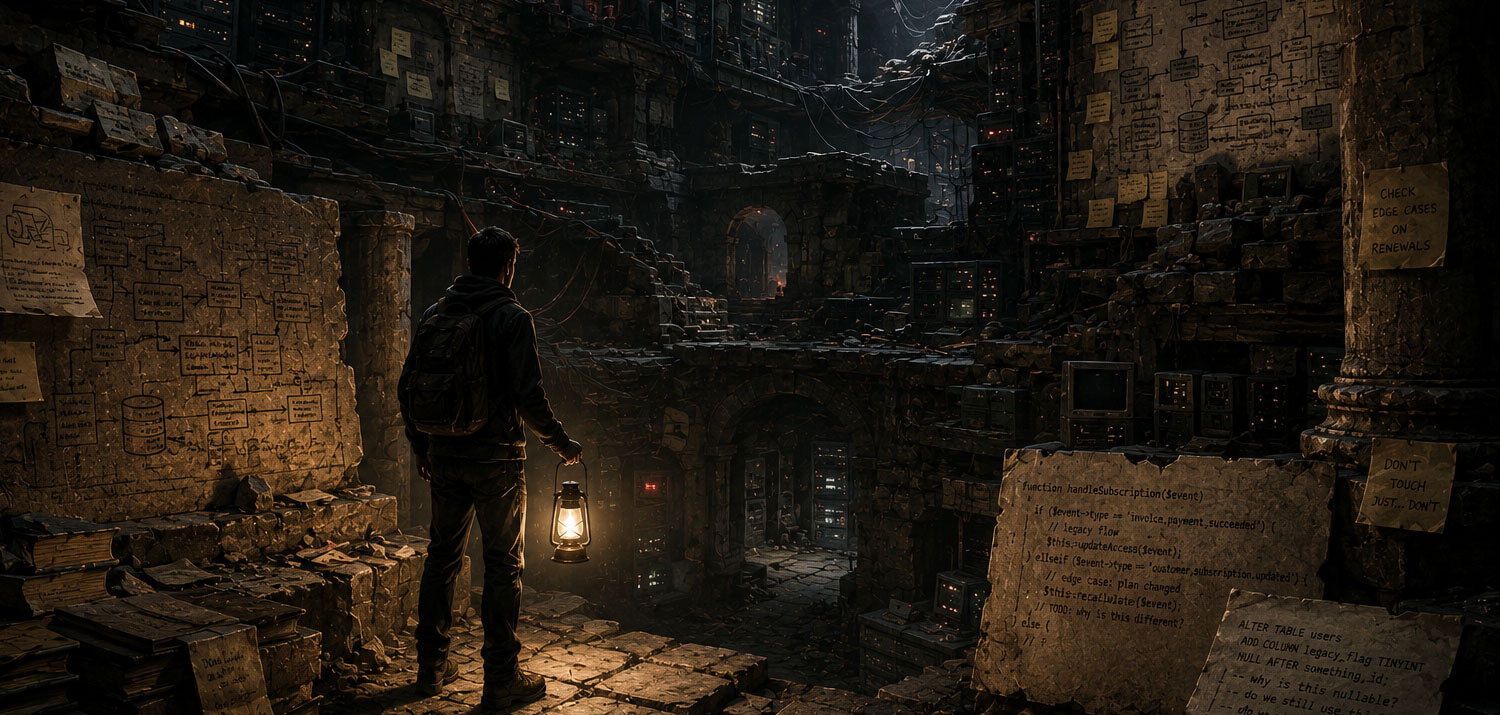
This is the phase where developers become archaeologists. Where Git blame reveals the person responsible was you three years ago.
The work changes in character. Less of it is building new things; more of it is excavation. Tracing a data flow means following a chain of method calls through six files, through a service class that was meant to be temporary, into a model that does things models were never supposed to do, and finally into a database table whose schema hasn't been touched in three years because nobody remembers what the nullable column is for or whether anything depends on it being nullable. Fixing a bug means first understanding why the behavior exists at all. That means reading code that has no real author anymore, only a git history.
There is always a file named something like FinalHelperV2.php. It has 2,400 lines. It is called from forty-seven places. It mixes HTTP concerns with business logic with database queries with string formatting utilities, because over time it became the place where things got put when nobody was sure where else to put them. Nobody knows what half of it does. Nobody is going to find out.
The system is no longer merely large. It has become difficult to reason about, and that is a different kind of problem entirely.
Boundaries Collapse
Every codebase has intended boundaries: the places where one concern ends and another begins, where business logic is supposed to live, what a given class is and isn't responsible for. In Phase 4, those boundaries have mostly stopped mattering in practice.
Business rules that should live in one place now live in several. Validation that should belong in a Form Request also runs, inconsistently, in the import pipeline, and slightly differently in the API controller, because each was written by a different person under different pressures. The model has validation logic in it too, added at some point by someone who needed it to be there and didn't have time to find the right place. Three versions of the same rule, none of them quite identical, all of them quietly diverging over time.
Abstractions that were meant to hide complexity have leaked. The code that depends on them has to know more about how they work than it was ever supposed to. Service classes have grown into something closer to second controllers. Eloquent models have swallowed concerns that belong in the application layer. Traits have been used in ways that make the class hierarchy genuinely difficult to follow, because PHP traits were not designed for the things they are commonly asked to do once a codebase reaches a certain age.
Ownership is unclear because the lines were never formally drawn and the implicit ones have blurred. The give a shit is real in the team but the lines are dotted. When a bug touches three domains, nobody is sure whose job it is to fix. The architecture, such as it is, has become a description of how the system was originally imagined rather than how it actually works. The map stopped matching the territory gradually, and then completely.
Nobody would build the system this way today. The problem is that nobody built it this way on purpose.
Nobody Understands the Whole System
There is one developer who understands billing. Not because billing was assigned to them; because they were around when the edge cases accumulated and absorbed the knowledge through proximity and necessity (hey Chad! I remember you!). They know why the webhook handler has that particular retry condition. They know why subscription renewals run through a different code path than new signups. They know about the Stripe event that arrives out of order and how the system quietly compensates for it. That knowledge lives in their head. It is not written down anywhere that would survive their departure.
This is tribal knowledge, and every mature codebase is full of it. The onboarding experience for a new engineer is not reading documentation, because the documentation is incomplete, out of date, and describes a version of the system that no longer exists. It is a weeks-long process of finding out what questions to ask and who to ask them to. It is learning which parts of the system to approach carefully and which to avoid entirely, not from any formal source, but from offhand comments and the specific expressions on people's faces when certain class names come up in a review.
Institutional memory is irreplaceable and fragile. When the developer who understands billing leaves, there is no clean handoff. There is a gap that takes eighteen months to partially fill. Some of what was known is simply gone.
Key-person risk in a software organization is rarely about a single point of failure in the infrastructure. It is almost always about a single point of failure in the understanding of the infrastructure.
Complexity Creates Defensive Development
Here's something that doesn't get discussed enough: complex systems change the behavior of the people who maintain them. Not because those people are bad engineers; because they're rational ones.
When a codebase is large and poorly understood, touching it carries real risk. A change that looks local can have effects three layers away. A refactor that seems contained can surface behaviors that nobody anticipated, in a part of the system that wasn't supposed to be involved. Developers learn this through experience, and they adjust accordingly. They make smaller changes. They avoid the files that have surprised them before. They write more PHPUnit tests for the things they're worried about, and the list of things they're worried about is long. They add review steps. They schedule extra time to talk through a change before making it.
"Don't touch that" isn't laziness. It's a survival strategy developed in response to a system that has made touching things expensive. Fear-driven development is what rational engineers do when the cost of being wrong has become high enough that caution is the correct default. The tragedy is not that developers behave this way; it's that the system has trained them to.
The platform doesn't just become harder to change. It actively reshapes how the team works, how long things take, and which decisions feel acceptable. The codebase has become a constraint on organizational behavior. That means the technical problem is now also a people and process problem, and solving the technical problem requires first acknowledging the organizational one.
Observability Becomes Survival
At some point, understanding what the software is doing in production stops being a nice-to-have and becomes the prerequisite for keeping the lights on. Structured logs, error aggregation in Sentry or Bugsnag, query monitors catching N+1 regressions, Laravel Telescope in staging, custom log channels for the billing pipeline that has burned people enough times to earn dedicated visibility: none of this is the product, but all of it becomes as important as the product. Without it, runtime behavior is effectively invisible.
Half of modern software infrastructure exists because nobody understands the original infrastructure anymore.
This is not cynicism; it's an accurate description of what is happening. The observability tooling is a second system built to explain the first one. The dashboards are an attempt to make legible a codebase that has become too complex to reason about from reading it. The custom log channels exist because when something goes wrong in the billing pipeline at two in the morning, there's no other way to follow what actually happened through six service classes, two queued jobs, and a webhook handler that may or may not have fired in the expected order.
The investment in observability is worthwhile and necessary. It is also, in part, a workaround for a deeper problem: a system complex enough to require this much instrumentation to understand has complexity that should probably be addressed at the source, not papered over with dashboards.
Velocity Collapses Gradually
The slowdown does not arrive all at once. It is incremental, which makes it harder to attribute and easier to rationalize quarter by quarter until it is undeniable.
Simple changes start taking a week. Not because the change itself is hard, but because understanding the full context is hard, and testing it thoroughly is hard, and verifying that nothing unexpected breaks is hard. A production issue that would have taken an hour to diagnose in Phase 2 now takes two days, because the path through the system is long and the tools for following it are imperfect and the person who would have known immediately left last year.
Regressions become a regular feature of the release process rather than an occasional surprise. Support burden grows as the surface area for things to go wrong expands. Operational overhead, the work of just keeping the system running, dependencies updated, queue workers healthy, scheduled tasks monitored, consumes an increasing share of the team's capacity and generates no visible output.
Management sees a team working hard and shipping slowly. The instinct is to add engineers, which helps less than expected, because the bottleneck is not capacity; it is comprehensibility. More engineers on an incomprehensible system produces more code, more surface area, more interactions to reason about, and eventually more complexity. The problem scales with the team.
At this stage the platform still technically works. The problem is that every future decision now carries exponentially more risk than it should.
Phase 5 is where the architecture itself begins actively resisting change. That is not a metaphor.